
How to Build a B2B-Only Reward Bar for Wholesale Buyer Retention in Shopify
Wholesale buyer relationships live and die on consistency. Predictable terms, repeat-order incentives, the occasional thank-you gift - those are the levers that keep a company account ordering from you instead of from the next supplier with a price list. If you're searching for how to build a B2B-only reward bar for wholesale buyer retention in Shopify, the goal isn't a flashier cart. It's a reward stack sized for wholesale order patterns that retail traffic never sees and never expects.
Since Shopify rolled native B2B out to every paid plan in April 2026, more stores are running mixed DTC and B2B traffic through one drawer than ever before. With the global B2B ecommerce market projected at $36 trillion by 2026, the cart needs to recognize who's buying - and reward them differently.
Why Wholesale Retention Looks Different
Acquiring a new wholesale account is expensive - credit checks, payment-terms negotiation, sometimes a sales call. Once a company places its first order, the goal shifts to retention, which in B2B means frequency, not just lifetime value. A wholesale account that places four orders a year at $2,000 is worth far more than one $8,000 order: repeat ordering smooths your forecast and signals the buyer is treating you as a primary supplier.
The shape of the rewards matters too. A wholesale buyer isn't motivated by a $5 free shipping bar or a $25 candle gift-with-purchase - those are retail tactics. Wholesale retention rewards look more like:
- A volume discount ladder at thresholds that match wholesale order sizes
- A quarterly thank-you gift triggered above a meaningful B2B spend
- A free-shipping bar sized for established company-account restock orders
Run all three behind a single condition that hides the entire stack from retail traffic, and you get a B2B-only reward experience that never bleeds into DTC.
The Condition That Hides It All
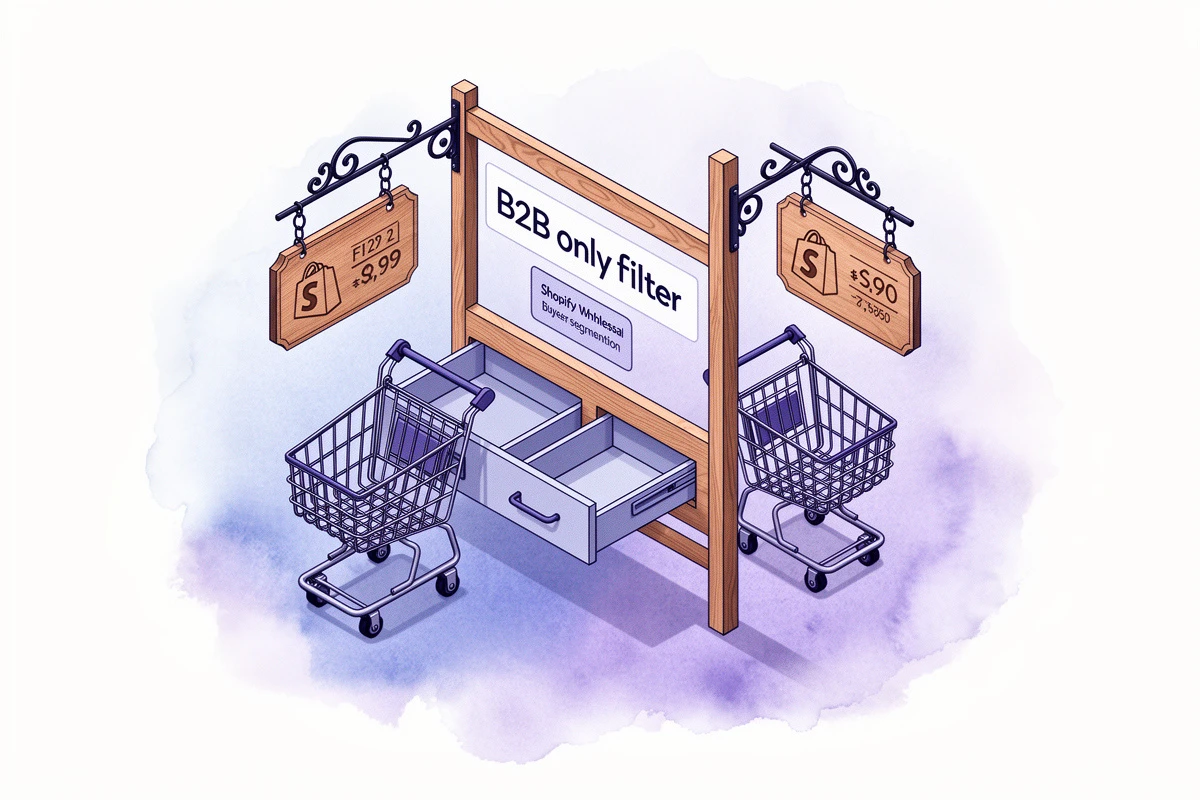
The mechanism is one per-reward condition. In Cart Designer → Rewards, every reward has a Conditions card with a condition called Customer is a B2B customer. It matches the moment a buyer signs in against a Shopify company account - no tag, no segment, no app integration. The same condition is enforced in the storefront reward bar (deciding whether the tier renders) and inside the order-discount function at checkout (deciding whether the discount actually applies).
Add it to every reward in the stack and the entire bar disappears for DTC traffic. Retail shoppers never see a "Spend $1,000 for 10% off" tier and never wonder why they can't reach it. Wholesale buyers, the moment they're signed in, see a reward bar built entirely for them.
For the broader picture of what conditions can do, see the complete guide to cart reward visibility conditions. For this article, only the B2B condition is needed.
Component 1: A Volume Discount Ladder Sized for Wholesale
A retail discount ladder might tier at $50, $100, and $150. A B2B ladder tiers at $500, $1,000, and $2,500 - order sizes that mean something to a buyer placing case-pack or pallet orders.
A practical ladder for a wholesale account that already has a baseline catalog discount:
| Threshold | Reward | Condition |
|---|---|---|
| $500 | 5% off the order | Customer is a B2B customer |
| $1,000 | 10% off the order | Customer is a B2B customer |
| $2,500 | 15% off the order | Customer is a B2B customer |
Each tier is a Discount (advanced) reward. EliteCart's discount function applies the discount automatically at checkout when a B2B buyer crosses a threshold - no separate Shopify automatic discount to configure, and only the highest qualifying tier applies. The ladder lives on top of whatever base wholesale rate your catalogs and price lists already set.
This is a volume-incentive promotion, not a contract change. Catalogs own the negotiated rate; the cart adds the consolidation incentive. The full mechanics are in the tiered rewards guide.
Component 2: A Quarterly Thank-You Gift
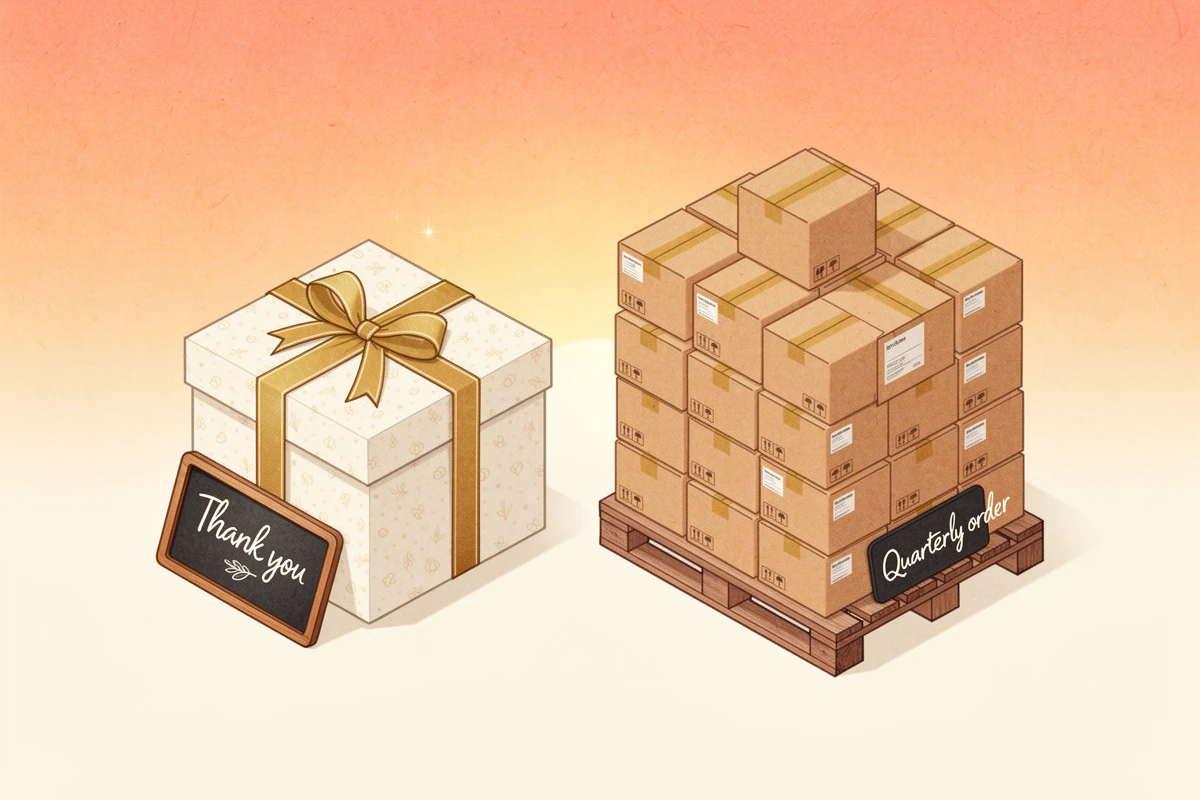
A quarterly free sample, branded notebook, or seasonal gift is a quiet but effective retention signal. It tells the buyer you notice they're ordering and gives a customer-success team a natural moment to follow up.
Set it up as a Single gift or Multi gift reward at a threshold matched to your average B2B order - usually around the mid-tier of your discount ladder. Add the Customer is a B2B customer condition. Rotate the SKU each quarter so repeat buyers see something fresh each time they cross the threshold.
A few practical notes:
- The gift can be a real wholesale SKU. Sample packs, single-unit versions of bulk items, or end-of-line stock all work - they cost less than retail-priced gifts and showcase products to the buying decision-maker.
- Use a Multi gift if the audience is varied. Different industries within your wholesale book often want different items; letting the buyer pick keeps the gift relevant.
The same gift mechanics work for letting customers choose their own free gift, just gated to the B2B condition.
Component 3: A Lower Free-Shipping Bar for Repeat Restocks
Wholesale buyers do two kinds of orders: large quarterly stock-ups and smaller restocks to plug inventory holes. The discount ladder rewards the big orders; the free-shipping bar is where you reward the small ones.
A B2B free-shipping bar should sit below the entry tier of the discount ladder. If a typical restock is $300-$500, a free-shipping bar at $300 means a buyer placing a small midweek order still has something to clear - and the easiest path is to add the missing case rather than wait until they hit $1,000.
For an established company account you specifically want to keep restocking with you, add the threshold even lower behind a tag overlay:
- A B2B-wide free-shipping bar at $500 with Customer is a B2B customer
- A "repeat buyer" free-shipping bar at $250 with Customer is a B2B customer AND Customer has tag: established-account
Tag company accounts after their second or third order via Shopify Flow. The combination of the native B2B flag plus the tag overlay narrows the lower threshold to buyers you actively want repeat orders from. The base free-shipping progress bar setup covers the underlying configuration; only the conditions change.
Putting the B2B-Only Reward Bar Together
The full reward bar for a wholesale-only audience is five rewards, all gated to Customer is a B2B customer:
- Free shipping at $500 (or $250 for established accounts)
- 5% off at $500
- Quarterly gift at $1,000
- 10% off at $1,000
- 15% off at $2,500
A DTC shopper opening the same cart drawer sees none of this. The B2B condition is the audience switch; thresholds and reward types are sized for wholesale economics. For the DTC side, run a separate set of rewards with Customer is not a B2B customer - the mixed DTC and B2B playbook walks through how the two stacks coexist in one drawer.
Setup Steps
- Go to Cart Designer → Rewards and open the Rewards tab
- Click Add reward and pick the type (Shipping, Single gift, Multi gift, or Discount (advanced))
- Set the threshold sized for wholesale order patterns
- Open the reward's settings panel and expand the Conditions card
- Click Add condition and select Customer is a B2B customer
- Save
- Repeat for each component of the stack
Per-reward conditions are available on the Professional plan. The full setup walkthrough is in the Rewards V2 guide.
Testing the B2B-Only Stack
Before going live, sign in as a customer attached to one of your company accounts (created in Shopify Admin → Customers → Companies) and confirm every tier in the B2B stack renders. Then sign in as a regular DTC customer - or browse as a guest - and confirm none of the wholesale rewards appear. Guests never match the B2B condition, so they always see the retail experience.
If part of your wholesale book runs through a third-party app like SparkLayer instead of native Shopify B2B, those buyers won't carry the native flag - you'll need a tag-based approach for them instead. The SparkLayer integration guide covers that setup.
Wholesale retention is a quiet game. Predictable terms, repeat-order incentives, and the occasional thank-you. A B2B-only reward bar built on a single condition lets you run that game inside the same storefront that serves retail - without ever letting DTC traffic see the rewards meant for your wholesale book.