
Announcement Banners in Your Cart: When and How to Use Them
Your customer has added items to their cart. They're interested - but not yet committed. Well-placed announcement banners can tip the scale from browsing to buying.
Cart banners serve a different purpose than site-wide header banners. Header banners broadcast to everyone; cart banners speak directly to customers who've already shown intent. They're further down the funnel and more receptive to timely, relevant information.
The challenge is using this attention wisely. Done right, cart banners drive conversions and create genuine value. Done poorly, they erode trust and contribute to "urgency fatigue."
When Announcement Banners Actually Work
Not every message belongs in the cart. The best banners are timely, actionable, and genuinely useful at that moment.
Flash Sales and Limited-Time Offers
Flash sales create legitimate time pressure, and the cart is the natural place to reinforce it. A customer who added items during your Black Friday sale but hasn't checked out needs to know the sale ends at midnight.
Cart abandonment rates spike during holiday sales - reaching 80% during Black Friday and Cyber Monday. Customers comparison shop across multiple tabs, intending to return "later" without realizing the deal won't last. Understanding why customers abandon carts helps you craft banners that address their concerns directly.
A banner that says "BLACK FRIDAY ENDS IN 4:32:15" serves as a genuine reminder. It's not manipulation - it's information the customer needs to make a decision.
Shipping Deadlines
Holiday shipping cutoffs are high-stakes information. A customer buying a gift who misses the deadline has a genuinely bad experience - and a banner that prevents that creates real value.
"Order by December 18th for guaranteed Christmas delivery" is useful, time-sensitive information at the exact moment it matters. Shipping-related issues account for over 60% of cart abandonment, and unclear delivery timelines are a top reason customers leave without buying.
Low-Stock Urgency
This is where cart banners get ethically complicated. "Only 3 left in stock" messages can be powerful conversion drivers - but only if they're true.
When inventory data is accurate, low-stock banners help customers make informed decisions. They might want to purchase now rather than risk the item selling out.
The problem is manufactured scarcity. Customers have grown skeptical after being burned by fake "limited stock" warnings that reset on page refresh. Banner blindness has reached new heights, with visitors actively avoiding areas where they expect fake urgency.
If your inventory system supports real-time stock data, low-stock alerts can be effective. If you're tempted to fake scarcity, don't - the short-term conversion lift isn't worth the long-term trust damage.
Holiday and Seasonal Promotions
Seasonal banners work because they're inherently time-bound. Valentine's Day, Mother's Day, Back-to-School - these create natural urgency without feeling artificial.
"Free gift wrapping on orders over $50 through Valentine's Day" combines a seasonal hook with a specific threshold. The urgency is built into the calendar.
The Psychology of Countdown Timers

Countdown timers tap into loss aversion - the psychological principle that people feel losses more strongly than equivalent gains. Watching seconds tick away triggers a fear of missing out that motivates action.
Research shows that countdown timers can increase conversions by 30-50% when used authentically. Case studies have documented 200-300% conversion increases during Black Friday campaigns.
But here's the caveat: these results come from legitimate, time-limited offers. When customers discover the timer resets or the "limited time" offer is always available, they stop believing any urgency messaging - even when it's real.
Using Timers Effectively
Session countdown timers show a countdown when customers open their cart. "Complete your order in {countdown}" encourages faster decisions. Note that these are visual countdowns only - they don't reserve inventory or lock in prices.
Sale countdown timers work for genuine time-limited promotions. End-of-season sales, flash sales, and holiday promotions have real end dates customers benefit from knowing.
Shipping cutoff timers help customers who need items by a specific date. "Order in the next 2:15:30 for same-day shipping" provides useful information that drives action.
When Timers Backfire
Timers become counterproductive when:
- They reset on page load - Customers notice this and lose trust
- The offer continues after "expiration" - This is the fastest way to train customers to ignore your messaging
- They're used constantly - If everything is always urgent, nothing is urgent
- They're too short - A 30-second timer on a $200 purchase feels manipulative, not urgent
The goal isn't to pressure customers into hasty decisions - it's to help them act on decisions they've already largely made.
Strategic Cart Banner Positioning
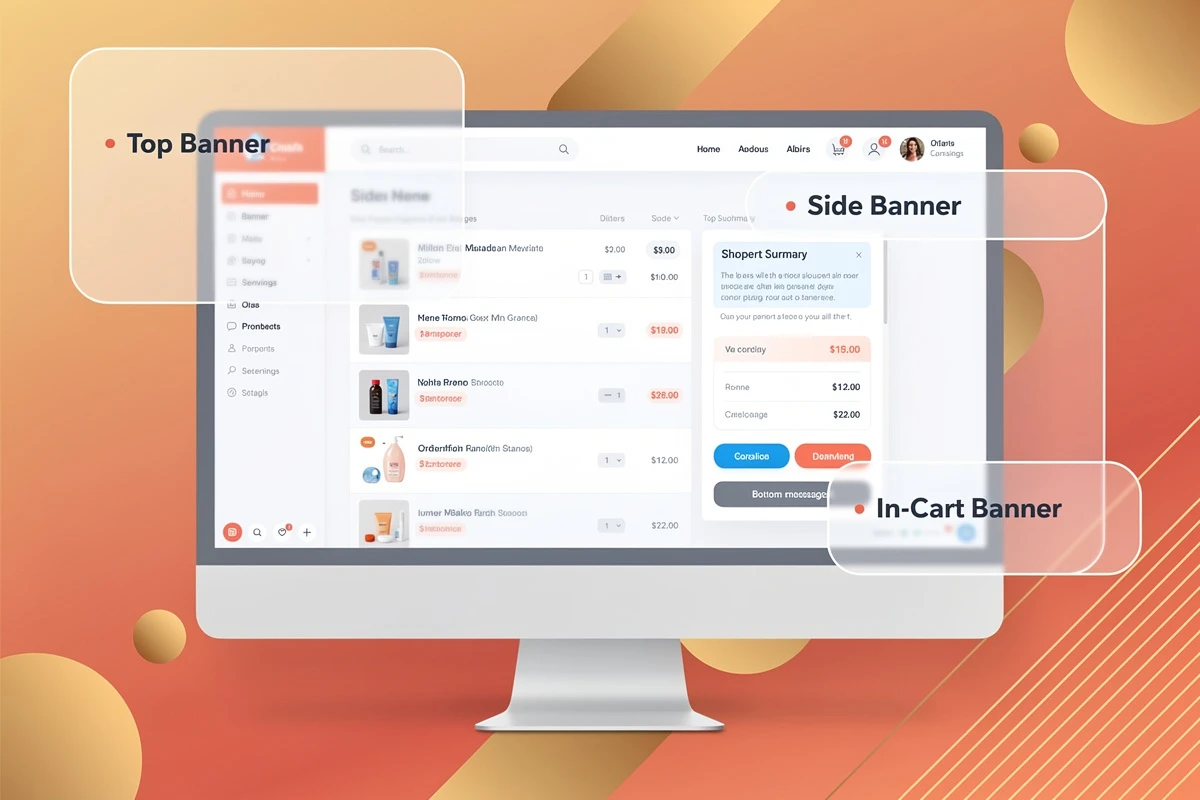
Where you place the banner affects how customers perceive it. Four position options serve different messaging needs:
Top of cart (sticky) keeps the message visible as customers scroll. Use this for your most important communications - active flash sales, critical shipping deadlines, or major promotions.
Above line items places the banner before customers see their products. This works for informational messages - "Shipping delays expected: 2-3 additional days to West Coast addresses."
Below line items catches customers after they've reviewed products but before checkout. Good for promotional nudges - "Add $15 more for free gift wrapping." This positioning pairs especially well with a reward bar that shows progress toward thresholds.
Above cart summary (sticky) keeps the message near the checkout button. Effective for last-minute assurances like "Free returns within 30 days."
Crafting Banner Content That Converts
Effective cart banners share common traits: they're concise, specific, and action-oriented.
Be Specific
"Big sale happening now!" is vague and easy to ignore. "25% off ends tonight at midnight" is specific and actionable. Include exact discounts, specific deadlines, and precise thresholds.
Keep It Short
Customers glance at banners - they don't read them. Communicate in under 8 words. Use secondary text for supporting details if needed.
Primary: "FREE SHIPPING - $12 MORE TO QUALIFY" Secondary: "Add one more item to unlock free delivery"
Match Tone to Message
Urgent messages warrant bold treatment - all caps, contrasting colors, countdown timers. Informational messages should be subtler - standard case, muted colors, no timer.
Consider Multi-Language Stores
If you sell internationally, banner text needs translation - including date formats. European customers expect "18 Dec" not "Dec 18."
Scheduling Banners for Maximum Impact
Manual banner management doesn't scale. Forgetting to disable a "Black Friday Sale" banner on December 1st damages credibility. Scheduling banners to automatically show and hide based on dates eliminates this risk.
Use cases:
- Weekend promotions that run only Saturday and Sunday
- Business hours messaging like "Order in the next 3 hours for same-day shipping" that only displays when fulfillment is available
- Holiday campaigns with precise start and end dates
- Flash sales that run for specific hours
When the promotion ends, the banner disappears automatically.
Avoiding Urgency Fatigue

Customers exposed to constant urgency messaging stop responding. When everything is always urgent, nothing feels urgent.
Signs your store might be suffering from urgency fatigue:
- Click-through rates on promotional messaging declining over time
- Customers mentioning "fake sales" in reviews or support tickets
- Conversion improvements from urgency tactics diminishing
- Increasing cart abandonment despite more aggressive messaging
The solution is restraint. Reserve countdown timers for genuine time-limited offers. Use scheduling to ensure banners don't overstay their welcome.
Measuring Banner Effectiveness
Track these metrics to assess banner performance:
Conversion rate during banner display vs. without - A/B test by disabling the banner for a portion of traffic. If it isn't improving conversion, it's just noise.
Cart abandonment rate - Effective urgency messaging should reduce abandonment. If abandonment increases, your messaging might be creating pressure rather than value.
Time to checkout - Good urgency messaging shortens decision time without increasing refund rates or negative reviews.
Threshold achievement - If your banner promotes a spending threshold, track how often customers cross it during the campaign.
The best cart banners feel helpful, not pushy. They provide information customers need at the moment they need it. Flash sales have real end times. Shipping deadlines matter for gift-givers. Low stock affects purchasing decisions. Combined with other cart features like discount code fields and free gift offers, banners become one part of a cohesive cart experience.
Use banners to communicate these realities clearly and honestly. The conversions come from helping customers make informed decisions - not from manufacturing false urgency.