
Free Gifts in E-Commerce: Why They Work and How to Set Them Up

There's something irresistible about a free gift. Customers who would hesitate to add another item to their cart will happily spend $15 more to unlock a product they perceive as "free." This psychological quirk makes gift-with-purchase promotions one of the most effective tools for increasing average order value in e-commerce.
Unlike percentage discounts that eat into margins or free shipping that's become an expected baseline, free gifts create genuine excitement. They feel like a bonus rather than a correction to overpriced items. Let's explore why this works and how to implement gift promotions that actually drive results.
The Psychology of "Free"

The power of free gifts comes down to what behavioral economists call the zero price effect. Research consistently shows that people respond disproportionately to free items compared to items with even small prices. A $10 discount on a $50 purchase feels nice. A free $10 product feels special.
This happens because "free" eliminates the pain of paying entirely. There's no mental calculation of value versus cost - the gift is pure gain. Customers feel like they're winning rather than spending.
In Dan Ariely's book Predictably Irrational, a study demonstrated this perfectly: when people were offered a choice between a free $10 Amazon gift card or a $20 gift card for $7, more chose the free option - even though the paid option delivered $3 more value. The zero price effect overrides rational calculation.
Gift-with-purchase promotions also trigger reciprocity, a deep-seated social instinct. When someone gives you something, you feel compelled to give back. In the context of shopping, this translates to customers feeling good about completing their purchase and returning to your store in the future.
Research consistently shows that "free" triggers stronger emotional responses than equivalent discounts - even when the discount offers better objective value.
Why Free Gifts Beat Discounts
Percentage discounts have their place, but gifts offer several advantages:
Perceived value exceeds actual cost. A gift product worth $15 to the customer might only cost you $4-5 in materials and fulfillment. The perceived value far outweighs your margin impact - something that's rarely true with percentage discounts.
No conflict with other promotions. Discount codes in Shopify can conflict with each other. Running a 10% welcome discount alongside a 15% threshold discount creates configuration headaches. Free gifts operate independently - customers can use discount codes and still receive their gift. This flexibility makes them an effective complement to other cart-to-checkout conversion strategies.
Controlled inventory impact. You choose exactly which products serve as gifts - typically low-cost SKUs, samples, or end-of-season inventory.
Better brand perception. Gifts feel generous. Discounts can feel like an admission that products were overpriced.
Two Approaches: Merchant-Chosen vs. Customer-Chosen Gifts

How you present the gift matters almost as much as the gift itself. There are two fundamental approaches, each with distinct advantages.
Merchant-Chosen Gifts
With this approach, you select a single product that automatically adds to the cart when customers cross the threshold. The customer has no choice - they get what you've decided to offer.
When this works well:
- You have a signature item that showcases your brand
- The gift genuinely complements most purchases
- You want to move specific inventory
- You're testing a new product line
The psychology: Merchant-chosen gifts feel like a curated recommendation. There's no decision fatigue, and customers perceive you as the expert choosing what's best for them.
Customer-Chosen Gifts
Here, customers select their preferred gift from a small selection you've curated. When they hit the threshold, they see a carousel or popup showing their options.
When this works well:
- Your product line spans different preferences (colors, scents, flavors)
- You want higher engagement with the gift selection process
- The act of choosing creates additional investment in the purchase
The psychology: Letting customers choose triggers the endowment effect - people value things more when they feel ownership over the decision. A customer who selected their free lip balm from three options feels more connected to it than one who had it automatically added.
Three options is usually ideal - enough variety to feel meaningful, not so many that choosing becomes a burden.
Tiered Gift Thresholds: The AOV Multiplier
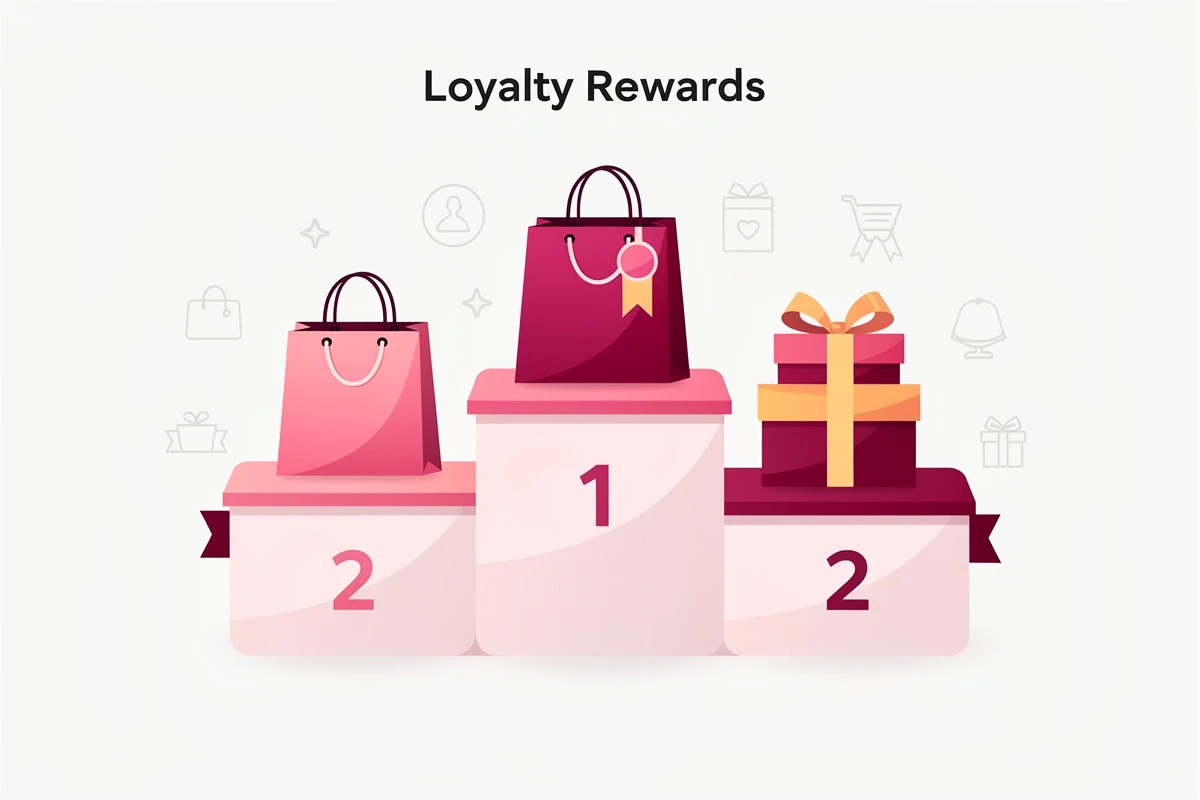
Single-threshold gifts work, but tiered rewards create something more powerful: a ladder of goals that keeps customers climbing.
Consider the difference:
Single reward:
- Spend $75 → Get a free travel pouch
Tiered rewards:
- Spend $50 → Get a free sample set
- Spend $100 → Get a free full-size product
- Spend $150 → Choose a premium gift
With tiered thresholds, customers who've already earned the first gift have a new target. The fragrance brand WHO IS ELIJAH implemented tiered gift-with-purchase during Black Friday 2024 and saw AOV increase by 46%.
The Goal-Gradient Effect in Action
The closer someone gets to a goal, the harder they push to reach it. This is the goal-gradient effect, and tiered rewards exploit it brilliantly. This same principle powers reward bars that drive higher average order values.
A customer at $42 will often add an $8 item to cross a $50 threshold. But if they're at $85, they're now just $15 from the next tier - and the upgraded gift makes that extra spend feel worthwhile.
Structure your tiers so the next level always feels achievable. Smaller increments between tiers encourage higher spending compared to larger gaps that feel out of reach.
Setting Your Thresholds
The recommended formula: set your first gift threshold 15-20% above your current average order value.
If your AOV is $65, a threshold around $75-80 pushes customers to add one more item while keeping the goal achievable. Each subsequent tier should feel reachable from the previous one - typically another 30-50% increase.
For tiered rewards:
- First tier: 15-20% above AOV (capture the majority of customers)
- Second tier: 50-75% above AOV (aspirational but achievable)
- Third tier: 100%+ above AOV (for your best customers)
Monitor your qualification rates. If more than 80% of orders qualify, the threshold is probably too low. If fewer than 30% reach it, it's too high. Aim for 50-60% as a starting point.
Choosing Effective Gift Products
Not all products make good gifts. The best gift-with-purchase items share specific characteristics:
High perceived value, low actual cost. Customers should feel they're getting something valuable. A $25 retail value product that costs you $5 is ideal.
Low shipping impact. Small, lightweight items that don't significantly increase shipping costs protect your margins.
Brand-representative. The gift should reflect your brand quality. A cheap-feeling item damages perception, even if it's free.
Broadly appealing. Unless you're using customer-chosen gifts, the item should work for most of your customer base.
Consumable or accessory items. Products customers use up create opportunities for repeat purchases. A free sample of a serum can lead to full-size orders. Consider rotating gifts periodically to keep the program fresh.
Setting Up Gift Rewards in Your Store
In EliteCart, navigate to Cart Designer → Rewards & free shipping to set up gift rewards:
- Select the Rewards tab and click Reward 1
- Enable the reward and select Product (single auto-added gift) or Multi product (customer chooses from a selection)
- Enter your threshold amount
- Click Select products to choose your gift product(s) - for multi-product rewards, you can select up to 3 options for customers to choose from
- Customize the "away from reward" message to show customers their progress
For customer-chosen gifts, configure the Gift chooser settings in the Settings & design tab to display options as a carousel or modal popup.
To create tiered gifts, enable Reward 2 and Reward 3 with progressively higher thresholds.
Protecting Your Margins
Gift programs can backfire if customers learn to game them. A few safeguards:
Run the math. Free gifts only boost profitability if the increased AOV outweighs the gift cost. If your margin is 40% and customers spend $20 more to get a $5-cost gift, you're gaining $3 per order. If the gift costs $12, you're losing money.
Exclude certain products from threshold calculations. Gift cards, already-discounted items, and the gift products themselves shouldn't count toward the threshold.
Enforce gift validity at checkout. Customers might add items to reach the threshold, claim their gift, then remove items. Server-side validation ensures the threshold is still met when the order is placed. EliteCart offers gift eligibility enforcement at checkout that blocks completion if customers haven't qualified for their gifts.
Measuring Success
Track these metrics after implementing gift rewards:
- Average order value - The primary metric
- Gift qualification rate - What percentage of orders earn the gift?
- Items per order - Are customers adding products to qualify?
- Gift redemption rate - For customer-chosen gifts, are customers making selections?
Free gifts work because they tap into fundamental human psychology - the irresistible appeal of getting something for nothing. The key is matching your threshold to customer behavior, choosing gifts that create genuine excitement, and monitoring the math to ensure profitability. Start with a single threshold, measure the results, then explore tiered rewards to push AOV even higher.