
Which Products Should You Upsell? A Margin-First Framework for Shopify Stores
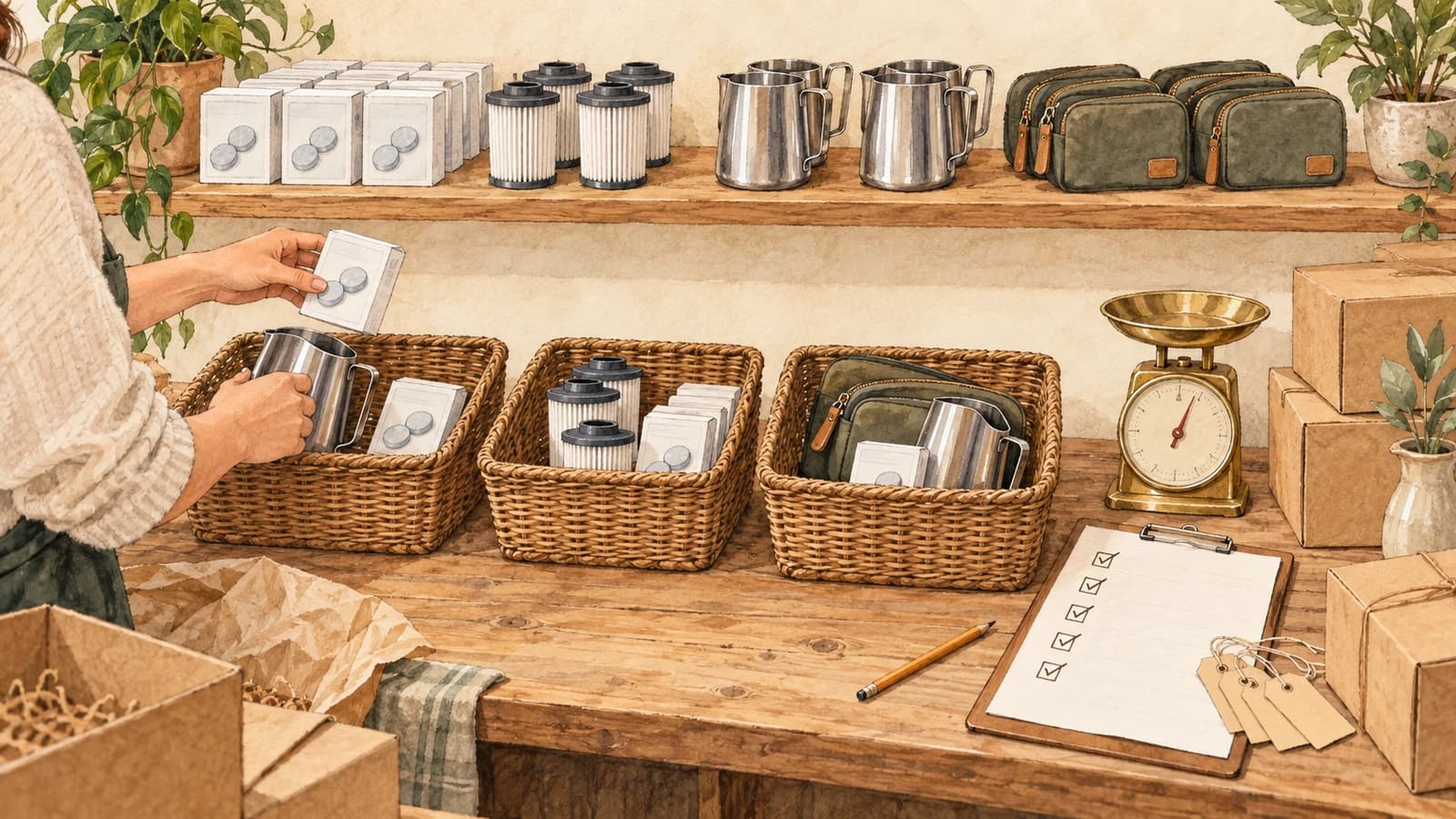
Most stores pick their upsell products by gut feel: a bestseller, whatever is overstocked, or the item the founder likes. That is how a cart ends up recommending a $6 sticker that ships in its own box, or a $90 accessory next to a $40 order. Deciding which products to upsell is a margin decision first and a relevance decision second.
This guide gives you eight criteria, a scoring worksheet you can fill in from a Shopify order export, and a simple way to turn the scores into cart placements. If you have ever asked what products to upsell and gotten "it depends" as the answer, this is the part it depends on.
What Products Should You Upsell? The Short Answer
The best products for upselling share four traits: they earn solid gross profit in dollars, they cost a small fraction of what is already in the cart, customers already buy them together with the main item, and they add almost nothing to your fulfillment cost.
Stock depth, return rate, and the rest act as tiebreakers or vetoes. A product that fails two or more of the four traits does not belong in your cart, no matter how popular it is.
The 8 Criteria for Choosing Upsell Products
1. Gross margin, in dollars and percent
Start with gross margin: price minus the cost of the goods, divided by price. But look at the dollar figure too. A 70% margin on a $5 item earns $3.50, while a 45% margin on a $30 item earns $13.50.
If you plan to put a discount on the upsell, run the math after the discount. A 20% promotion on a 40% margin product halves the profit you make on it.
2. Price relative to the cart
An upsell should feel like a small extra, not a second purchase decision. A common rule of thumb in e-commerce is to keep add-on offers at around 25% or less of the main item or current order value. It is a guideline from practitioners, not a law, but it is a sensible starting point: an $80 order is a good fit for a $15 to $20 add-on and a poor fit for a $60 one.
Higher-priced upsells can still work on product pages, where the shopper is still deciding. Price logic by surface is a topic of its own, covered in price-aware product recommendations.
3. Attach rate
Attach rate is the share of orders containing your main product that also contain the add-on. It is your best evidence that a pairing works.
To calculate it, export 90 days of orders from Shopify admin, filter to orders that contain the main product, and count how many also include the candidate. Compare candidates against each other rather than against an industry benchmark: the top third of your attach rates are your strongest signals.
4. Complementarity
Ask one question: does this product help the shopper use, protect, or finish what they are already buying? Batteries for a toy, a case for a phone, and descaling tablets for an espresso machine all pass. A random bestseller from another category usually does not.
The closer the link, the less persuasion the upsell needs. If you are unsure whether a product should be an add-on or a step up to a better version of the main item, see cross-sell vs upsell.
5. Consumables and accessories
Refills, replacement parts, and care products are the classic upsells because they are relevant today and again next month. Add-ons that run out also bring customers back.
6. Stock depth
An upsell only earns money while it is in stock. Prefer add-ons with several weeks of stock cover, and treat thin inventory as a reason to wait until the next restock.
7. Return rate
Returns erase margin and add handling cost. The National Retail Federation estimated that 19.3% of online sales would be returned in 2025, so returns are not a rounding error. A product with an above-average return rate for your store (sizing issues, fragile packaging, "not as pictured" complaints) makes a weak upsell, because every return on an add-on wipes out the profit it was supposed to earn.
8. Shipping weight and size
The best add-on fits in the box you are already sending. Carriers usually bill the greater of the actual weight or the dimensional weight, which is based on box size. A light, compact add-on costs you almost nothing extra to ship. A bulky one can push the parcel into a larger box or a higher rate band and quietly consume the profit you made on it.
The Upsell Scoring Worksheet
Score each candidate from 1 to 3 on every criterion, multiply by the weight, and add up the total. Margin carries the most weight because it decides whether a conversion is worth anything at all.
| Criterion | Weight | 3 points | 2 points | 1 point |
|---|---|---|---|---|
| Gross margin | x3 | High margin and meaningful dollar profit | Average for your store | Thin, or tiny in dollars |
| Price vs main item | x2 | Around 25% or less | 25% to 50% | Over 50% |
| Attach rate | x2 | Top third of your candidates | Middle third | Bottom third or no data |
| Complementarity | x2 | Needed to use or protect the main item | Improves or extends it | Loosely related |
| Consumable or accessory | x1 | Used up within a few months | Replaced occasionally | One-time purchase |
| Stock depth | x1 | 8+ weeks of cover | 4 to 8 weeks | Under 4 weeks or unreliable |
| Return rate | x1 | Below your store average | Around average | Well above average |
| Shipping impact | x1 | Fits the existing box and rate | Small cost increase | Oversize or separate parcel |
The maximum score is 39 and the minimum is 13. As a starting point, treat 32 or more as a lead upsell, 24 to 31 as a solid supporting product, and below 24 as something to keep out of your add-on slots.
A worked example
An espresso machine store with a $180 main product scores three candidates:
| Candidate | Margin | Price | Attach | Fit | Consumable | Stock | Returns | Shipping | Total |
|---|---|---|---|---|---|---|---|---|---|
| Descaling tablets, $14 | 9 | 6 | 6 | 6 | 3 | 3 | 3 | 3 | 39 |
| Milk frothing jug, $24 | 6 | 6 | 4 | 6 | 1 | 2 | 3 | 3 | 31 |
| Burr grinder, $140 | 6 | 2 | 2 | 6 | 1 | 1 | 1 | 1 | 20 |
The descaling tablets are the obvious lead upsell. The frothing jug is a strong second. The grinder is a great product, but it is too expensive, too heavy, and too thinly stocked to be a cart add-on. It belongs on the product page as a considered purchase, not as an impulse extra.
How to Choose Upsell Products on Shopify: From Scores to Placements
There are two ways to act on the scores, and most stores need both.
Hand-pick your top scorers with manual flows
Your highest-scoring pairings are known quantities, so place them deliberately. In EliteCart, go to Upsells → Manual upsells → Add flow, set the Trigger type to Specific products or Collections, and add your top candidates under Upsell products. A flow holds up to 12 products, and you drag them into order, so the product with the best score goes first. Sold-out products are hidden automatically, and by default so are products already in the cart.
Let AI cover the long tail, with your rules on top
You will not score every product in a large catalog by hand. That is where AI recommendations help: under Upsells → AI upsells, EliteAI™ Ultra learns which products your customers buy together from your own order history, which is an attach rate calculation at catalog scale.
To keep the AI inside your margin framework, create a strategy in Fine-tune EliteAI™ Ultra. Start from the EliteAI™ Ultra Original base, which is built for accessories, refills, and natural add-ons, then translate your worksheet into rules:
- A Filter on price vs the trigger item with a ratio of at most 0.25 keeps suggestions within your price guideline.
- A Filter that excludes a tag such as
no-upsellkeeps high-return or bulky items out entirely. - A Boost on a tag such as
high-marginnudges your most profitable products up the ranking without removing others. - A Price compared to trigger item boost set to Cheaper favors low-friction add-ons.
Filters are hard rules and boosts are soft preferences, a distinction explained in depth in merchandising rules for product recommendations.
Common Mistakes When Picking Upsell Products
- Upselling your bestseller by default. Popular is not the same as profitable. A bestseller with a thin margin can fill your upsell slot while earning almost nothing.
- Ignoring fulfillment cost. A product with a healthy margin on paper can lose money once a bigger box or extra weight is factored in.
- Scoring once and forgetting. Costs, stock, and return rates change. Re-run the worksheet every quarter, or whenever a supplier raises prices.
- Discounting the upsell by reflex. A good add-on often converts at full price. Test without a discount before giving away margin.
FAQ
What are the best products for upselling?
Consumables and accessories that complement the main item, cost around a quarter of it or less, carry a healthy margin, and ship in the same box. Refills, care kits, spare parts, and protective accessories are typical examples.
How many products should I upsell at once?
Fewer than you think. Most cart surfaces show only a handful of products, and a short list of strong candidates beats a long list of weak ones. Rank by score and let the top few lead.
Should I use manual upsells or AI recommendations?
Both. Manual flows are ideal for the few pairings you know are profitable. AI recommendations cover the rest of the catalog, and rules on top keep them aligned with your margins.
Pick one main product this week and score five candidates for it. You will likely find that the item you are upselling today is not your top scorer, and swapping it in is one of the cheapest margin gains available to your store.